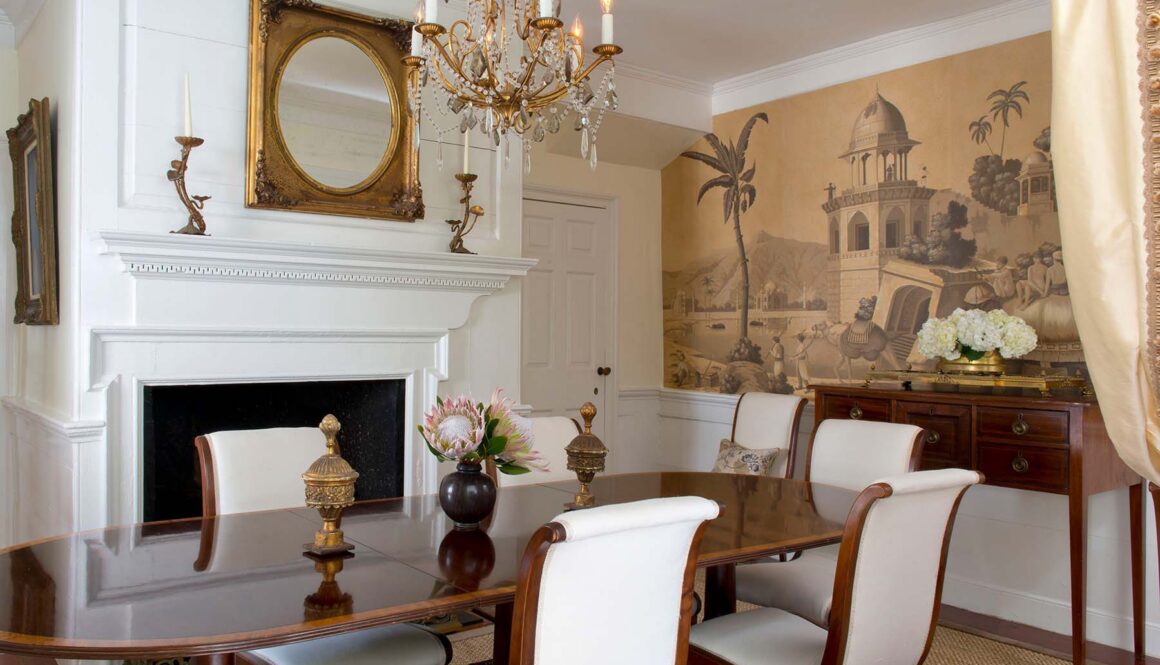
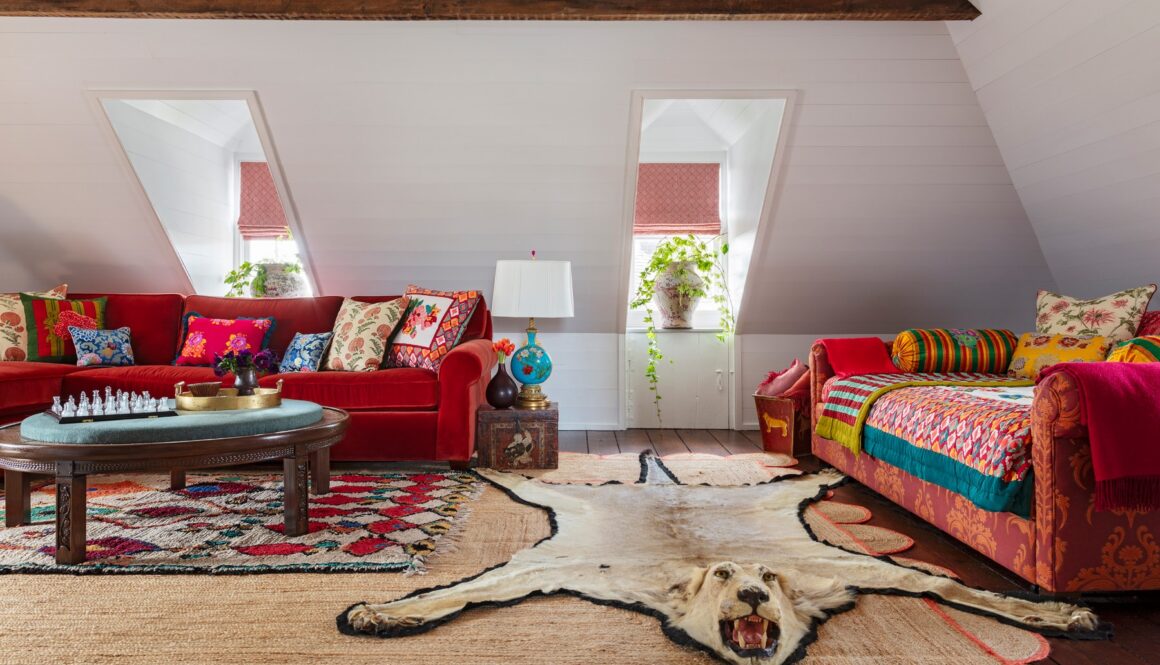
In Charleston’s French Quarter, one of the peninsula’s most storied neighborhoods, this residence was designed with a curated, layered approach to furnishings and craftsmanship that stays true to its character.
Rooms are built up slowly and intentionally, with fine materials, considered art, and pieces that carry history, so the whole feels gathered over time rather than installed in a season. It is livable luxury in a language rooted in the architecture and rhythm of historic Charleston.
The instinct is the same one I bring to every home: honor what is already there, and let each room become its own quiet atmosphere while the house remains whole.
The project has been featured in Luxe Interiors + Design, Charleston Magazine, Southern Home, The Post and Courier, and Rizzoli’s The Allure of Charleston. See more in the French Quarter portfolio.
If you’re designing a home in the French Quarter or elsewhere in historic Charleston, I’d love to hear about it as your Charleston interior designer.
A wedding is rarely a single evening anymore, and the surrounding events deserve as much intention as the day itself. For our own celebration, I designed each gathering as its own complete world, so that no two nights felt alike.
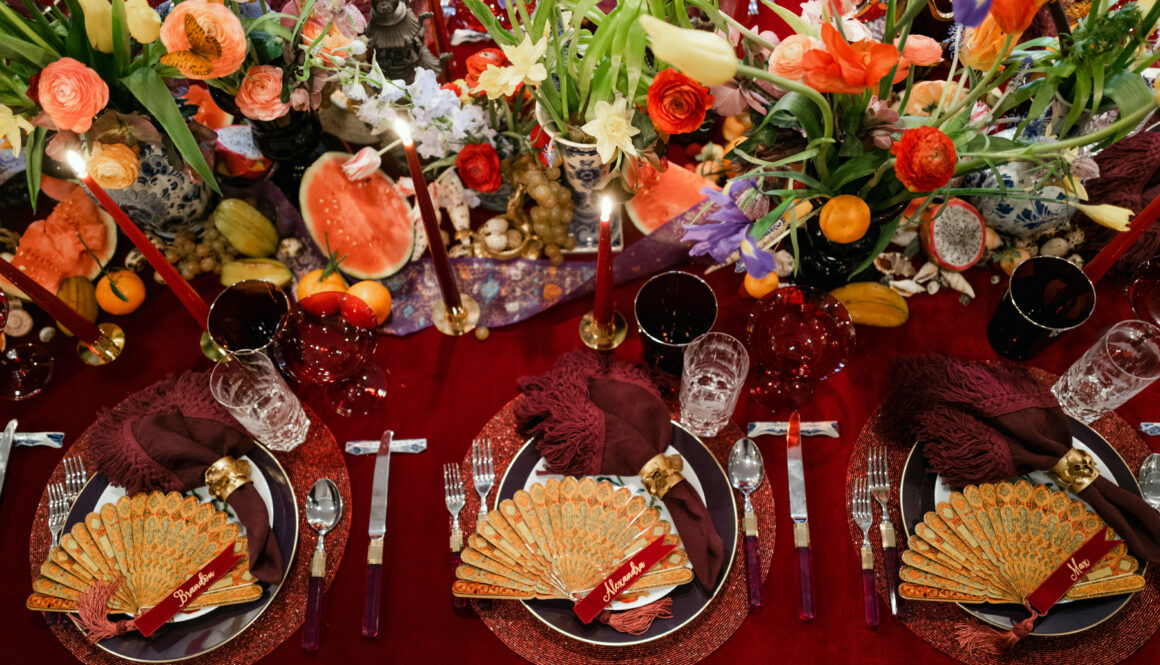
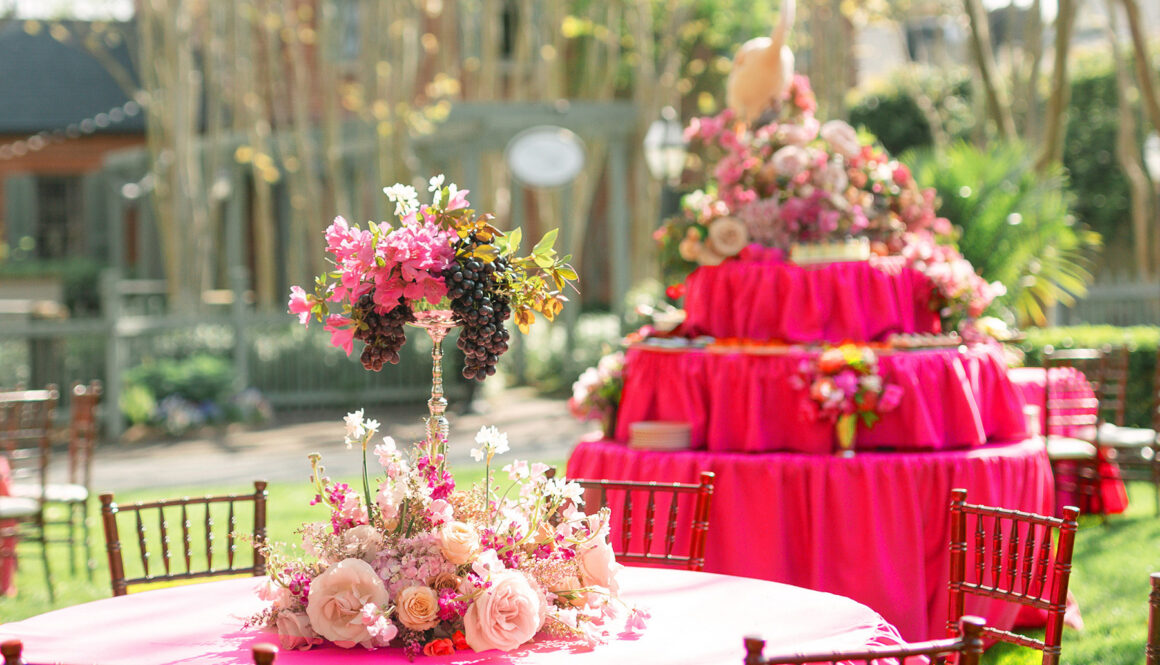
The welcome dinner took a celestial, zodiac theme, its paper goods and palette built around the night sky. The bridal luncheon turned in a different direction entirely: an Alice in Wonderland table in fuchsia and pale pink azaleas, playful and lush. The groom’s dinner became a Dutch still life, referencing the old master flower paintings, down to a gold gorilla in a ruby crown presiding over the room.
Composed, not repeated
The lesson I carry into clients’ weekends is this: a considered weekend is composed, not repeated. Each event should have a distinct point of view, carried through the invitation, the tablescape, the florals, and the light, while still feeling like chapters of one story. That is the same instinct I bring to an interior, where every room is its own atmosphere and the house is still whole.
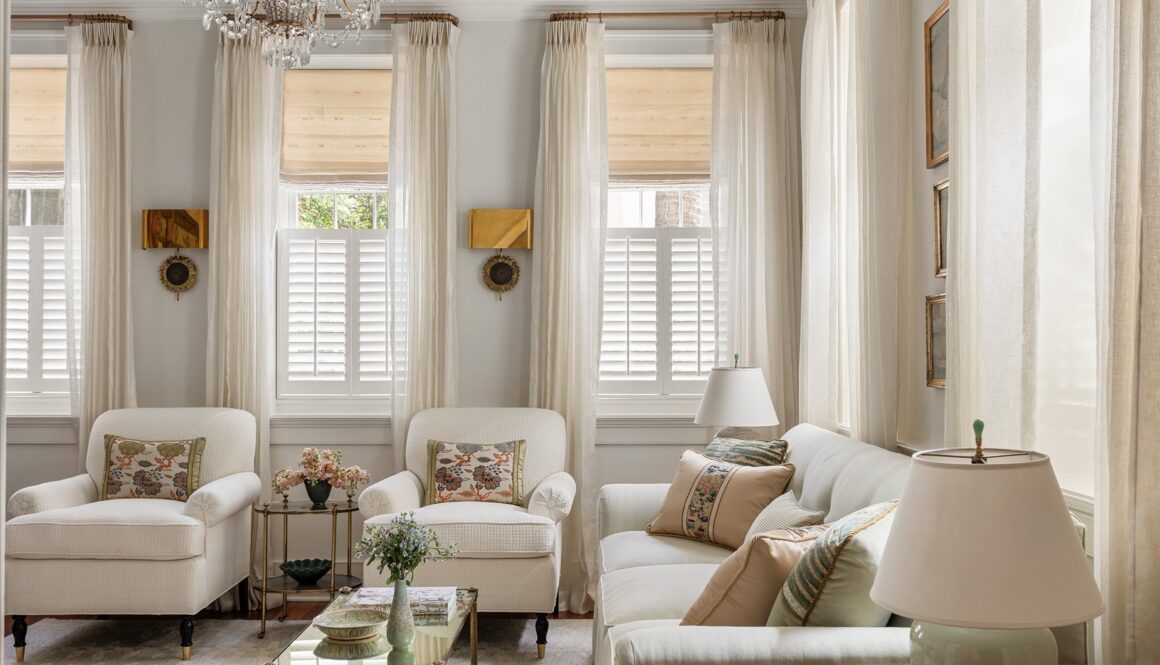
South of Broad is one of the most historic quarters of the Charleston peninsula, and a home there carries a particular responsibility. This residence was designed to honor the character of its architecture while introducing a fresh, livable sensibility.
Original detail is treated with reverence, and the layers added around it feel current, comfortable, and tailored to the family who lives there. It is the signature balance behind all of my Charleston work: Southern grace and cosmopolitan polish, a home that respects its provenance without ever feeling like a museum.
Rooms were built up slowly, with fine materials, considered art, and pieces chosen to last. The result is livable luxury, rooted in the architecture and rhythm of historic Charleston.
The project has been featured in Luxe Interiors + Design, Charleston Magazine, Southern Home, The Post and Courier, and Rizzoli’s The Allure of Charleston. See more in the South of Broad portfolio.
If you’re renovating or designing a home South of Broad, I’d love to hear about it as your Charleston interior designer.
Charleston is one of the most beautiful cities in the country to marry in, and part of designing a wedding here is choosing the right room for the story you want to tell. A few of the settings I return to, each with its own distinct character:
Historic downtown houses and halls
The Charleston Library Society, where we held our own ceremony, is a jewel of the peninsula, intimate, literary, and full of atmosphere. Grand historic houses and halls downtown offer the ballrooms and courtyards for a more formal celebration, steps from King Street.
Museums and gardens
The Gibbes Museum of Art and its Lenhardt Garden make an extraordinary setting for a tented reception, art and architecture as a backdrop. For something greener, the city’s historic gardens bring the Lowcountry itself into the celebration.
Lowcountry estates and plantations
Just beyond the peninsula, the area’s estates and plantation settings offer live oaks, marsh views, and space for a larger celebration that still feels rooted in place.
Wherever you marry, the venue is only the beginning. My work is to design a celebration that belongs to it, and to you. If you’re planning a Charleston wedding, I’d love to hear your vision as your Charleston wedding planner.
Some of the most rewarding interiors are the ones that ask you to work within a strong existing character rather than impose a new one. This Greenwich Village residence, in one of Manhattan’s most storied neighborhoods, was exactly that kind of project: designed from concept through installation, and layered for the way the client truly lives.
A prewar apartment comes with its own architecture and proportion, and the work is to honor those bones while making the rooms feel current and personal. The interiors here are enveloping and warm, yet unmistakably refined, built up through bespoke palettes, considered texture, and pieces collected to feel gathered rather than staged.
That is the through-line in all of my New York work: architecture and design married into a seamless whole, so a home reads as though it could only ever have looked this way. Southern warmth, cosmopolitan restraint.
If you’re designing or renovating a prewar apartment, townhouse, or residence in New York, I’d love to hear about it as your New York interior designer. See more of this project in the Greenwich Village portfolio.
Most of my work is designing celebrations for other people. This one was ours.
On March 18, 2023, I married Dr. Brandon von Tobel in Charleston, the city where I was born and raised. We met the modern way; Brandon likes to joke that given my design career I am very good at shopping online, so it was fitting that I picked out my husband while shopping on Bumble. Our first date was at the bar of The Bowery Hotel, and three and a half years later to the day, he proposed at home while I sat on the floor playing with our puppy, Chewie. He looked at me, ring in hand, and declared, “I want to spend the rest of my life with you.” Without missing a beat I replied, “Was there a question in there?” Who was in the right remains a topic of ongoing debate.
I planned our wedding myself. I had a clear aesthetic perspective, deep industry relationships, and a strong desire to design a bespoke weekend centered on curated antiques and meaningful objects, seen through an interior designer’s lens. I approached it the way I approach a home: not a single event, but a series of distinct, immersive worlds.
Finding the venues
As an avid gardener, I knew from the beginning that I wanted a garden wedding. One afternoon, walking down King Street, we stopped into the Charleston Library Society to pick up a few books we had reserved. Almost immediately, we knew we had found our venue. It did not hurt that the Gibbes Museum of Art shares a lot line with the library, allowing a natural transition from ceremony to reception in the museum’s historic Lenhardt Garden. Our wedding marked the first time the two adjacent institutions were used together, through their historic iron garden gates. Both sit at the terminus of the Charleston Garden Club’s famed Gateway Walk, a detail that felt serendipitous and deeply meaningful.
A palette drawn from a jewel
As I developed our inspiration board, I kept returning to the symbolism behind my engagement ring, which ultimately set the jewel-toned palette for the entire weekend.
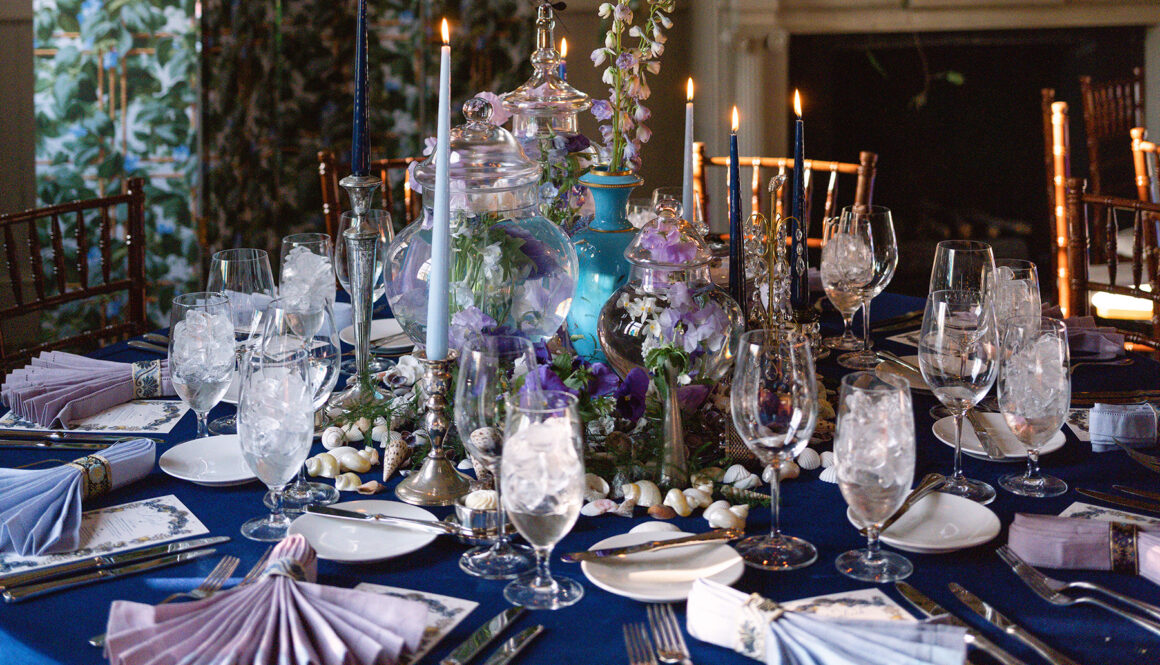
Brandon had designed the ring around a Colombian emerald, my May birthstone, flanked by trillion-cut diamonds for his April one. From that single stone, the weekend unfolded as three nights, three jewels: a sapphire welcome dinner where sea meets sky, a ruby Groom’s Dinner staged as a Dutch still life, and an emerald wedding day I called Alexandra’s Orangerie.
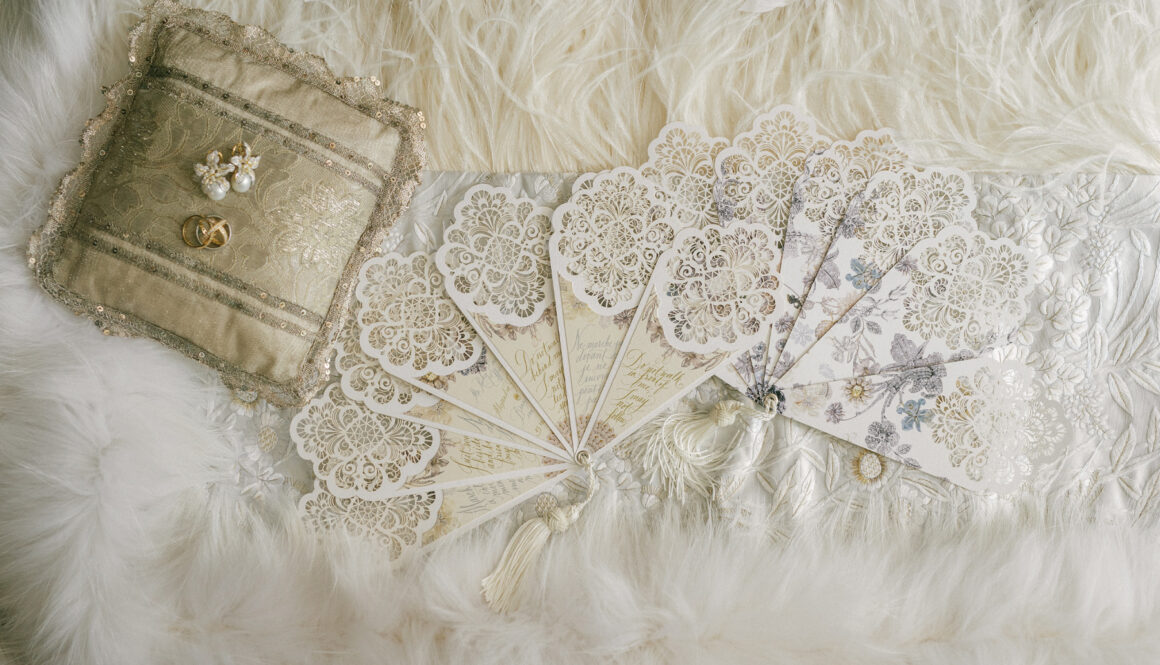
I firmly believe the invitation sets the tone for everything that follows, so we enlisted the calligrapher Stephanie Fishwick to design every printed piece, each woven with jeweled motifs keyed to its evening, and each crowned with a jeweled fan, a quiet nod to my logo. Ellen Weldon’s team produced the suite in an emerald velvet portfolio with a gold fan clasp engraved HvT. Those initials belonged to Brandon’s late father, Harry, an artist and a physician, and when we first saw the finished folders, we both cried.
The ceremony
It rained that morning, and the sky was still heavy as my father and I arrived at the library. At the top of the marble steps I clutched the cross on my late grandmother’s blue rosary beads, wrapped around my bouquet, looked up, and whispered, “I love you, Grandmom.” Just as the doors parted for my entrance, a brilliant ray of sunlight broke through the clouds. Guests still speak about that moment. Time seemed to stop.
We processed to Ludovico Einaudi’s “Experience,” arranged for piano and strings by Kiral Artists, wrote our own vows, and were married by a dear friend. As we began our recessional, a choir rose from the draped balcony above, singing “All You Need Is Love,” while musicians with brass instruments stood up one by one from among our guests: Brandon’s final surprise, lifted straight from our favorite holiday film. And as the serenade ended and we descended the steps, the church bells of Charleston began to toll across the city, right on cue.
Madeleine Castaing, under a tent
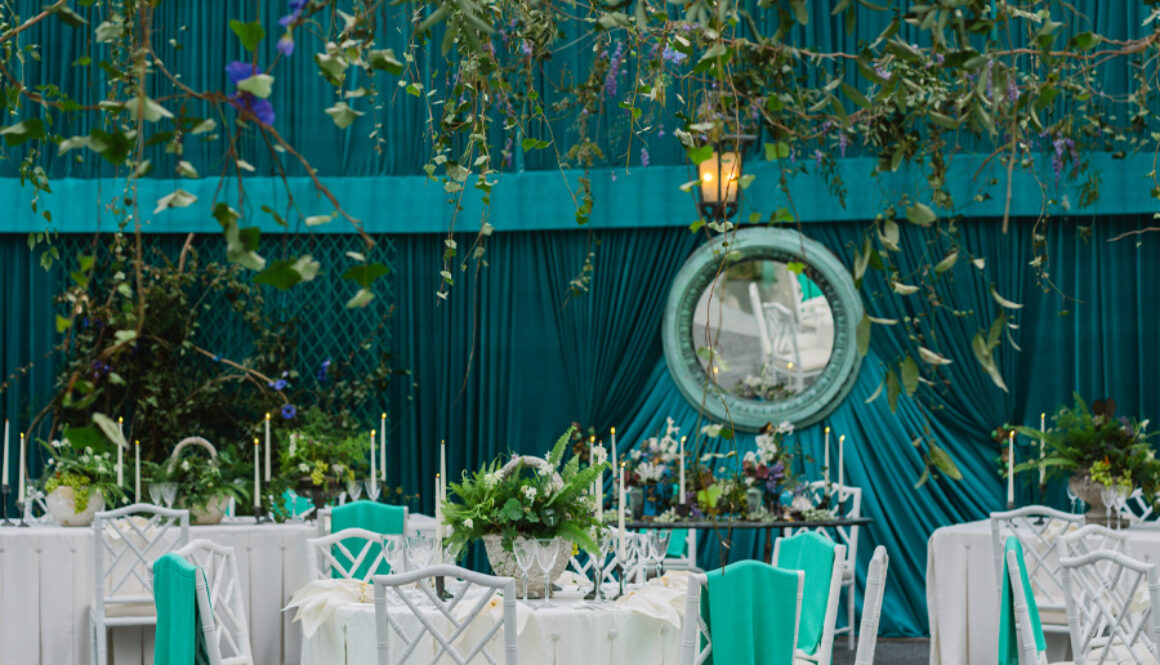
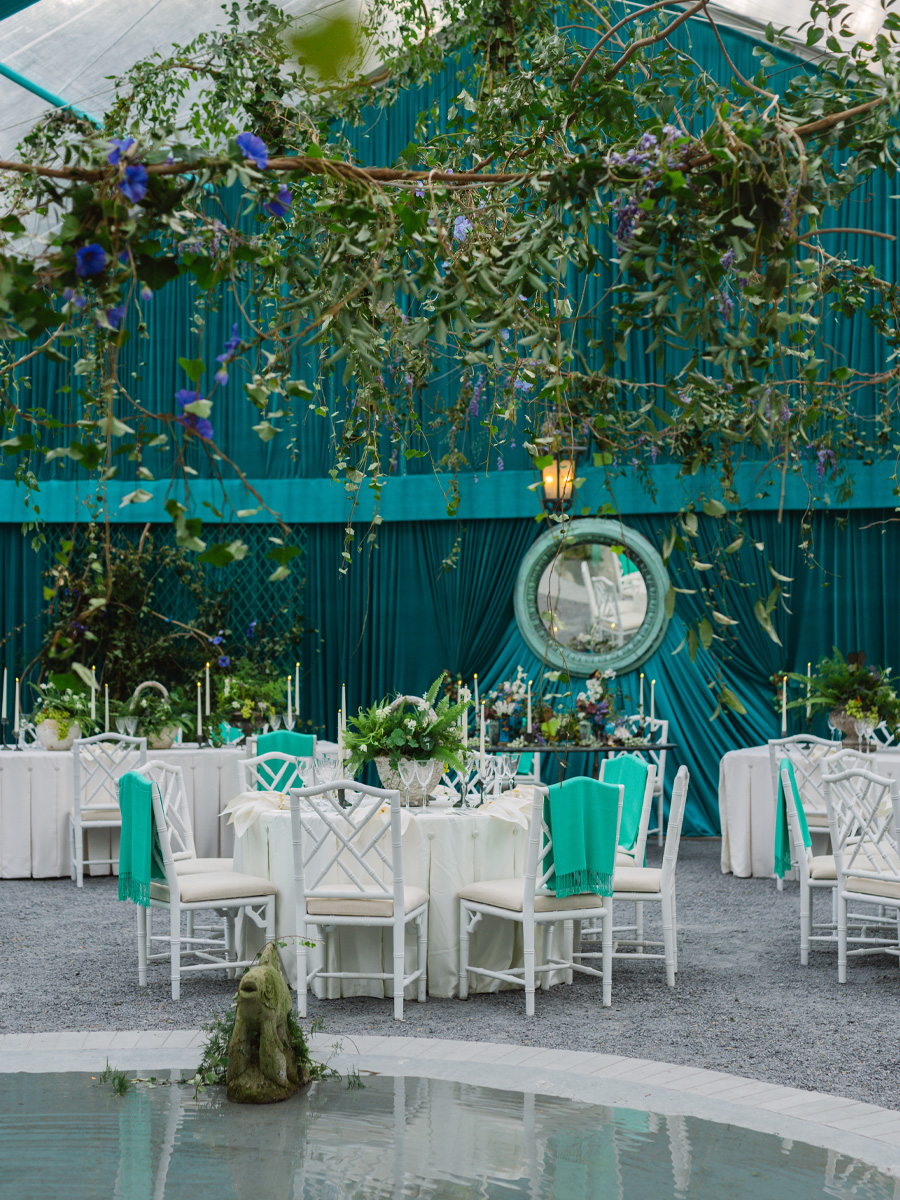
The tent’s exterior was designed to evoke a circus, because when is the merging of two families not a spectacle? Twin entrances were draped in peacock-blue velvet with apple-green fringe. Inside, the tent became a dilapidated French greenhouse in the spirit of Madeleine Castaing’s shop at 40 Rue Jacob: jade velvet walls, lattice hand-painted in Benjamin Moore’s Ming Jade, and unruly vines of ivy, wisteria, and morning glories trained overhead by Putnam Flowers as if untouched for decades. I wanted it to feel as though guests had been invited to dine in our long-abandoned greenhouse, one we had just dusted off and cleared of cobwebs for the evening. We left portions of the garden unfloored so the pea gravel could evoke the Jardin du Luxembourg, set our Grecian goddess in the fountain ringed by four antique stone goldfish, and let verdigris lanterns glow through the foliage.
Even the logistics were designed. In place of escort cards, guest names and tables were calligraphed onto sprigs of geranium leaves and gathered at a teak potting table against our antique black swan fountain. In place of a photo booth, our antique pagoda aviary, home to two bronze love cranes, became a vignette guests nicknamed the love jail.
The details I will never forget
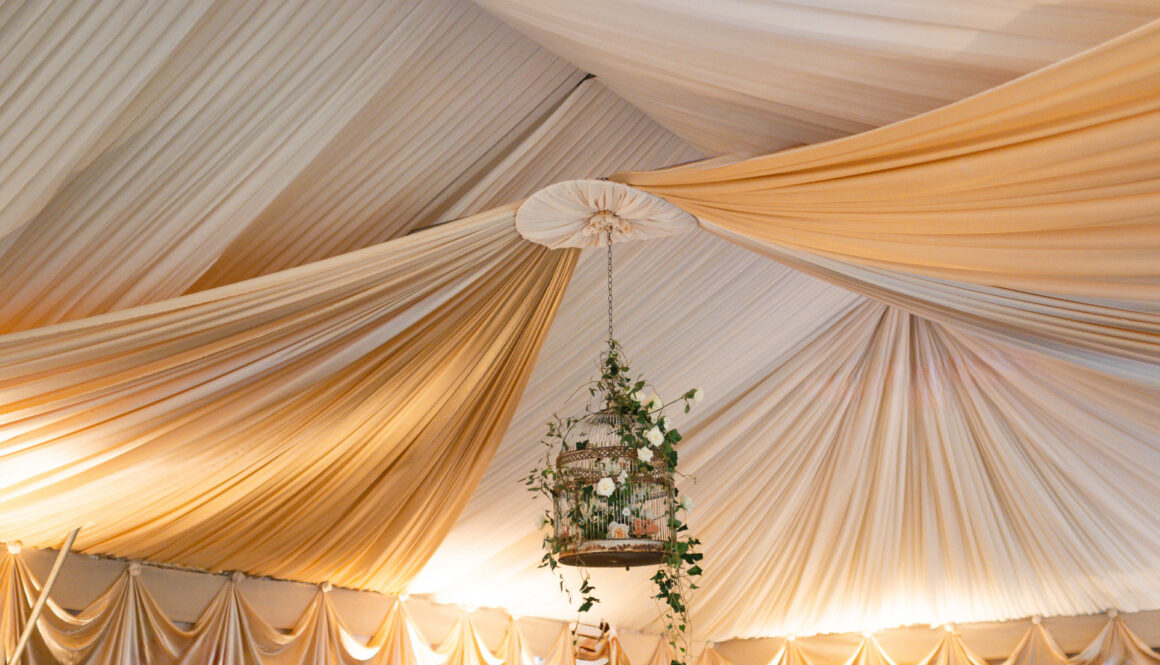
Tables wore custom ivory silk faille with inverted pleats and button detailing, anchored by stone jardinieres planted with elephant ears, caladiums, and ferns, bursting with grapes and dotted with taxidermy butterflies. Our head table, an antique green marble table from Zeze Found, was set with our own wedding china: hand-painted passionflower plates and etched lily-of-the-valley glassware from Talmaris in Paris, fluted Baccarat stemware, and antique Gorham lily silver. The passionflower napkin rings were hand-embroidered by the English embroiderer Jenny Adin Christie, who took our commission while simultaneously completing work for King Charles’s coronation.
The cake carried the most meaning. Ron Ben-Israel painted an ombre blue confection with florals and insects after a vintage Hermes scarf my grandmother had given me years earlier; we discovered only afterward that Hermes released the design the year I was born. She had passed just months before the wedding, so the cake was chocolate with orange buttercream, her favorite, and a note at the bottom of the menu told her story. We kept it a surprise for her seven children, my mother the youngest among them, and it became one of the most quietly emotional moments of the evening.
A light rain was falling as we left, to a blue convertible Bentley filled with calla lilies. Brandon drove us along the Battery with the top down, and we rode in complete silence, partly from exhaustion, partly from absolute bliss. There was nothing left to say. We had the wedding of our dreams.
Photography by Anne Rhett. Florals by Putnam Flowers. Stationery by Stephanie Fishwick and Ellen Weldon Design. Draping by Veil. Catering by Cru Catering. Cake by Ron Ben-Israel. Music by Kiral Artists. You can see the full feature in Over the Moon, and more of the celebration in the wedding portfolio.
Designing your own celebration
It was, in the end, the most personal project I will ever design, and the truest expression of how I think about celebration: one idea, held all the way through, from the first envelope to the last dance. If you’re planning a wedding in Charleston, I would be honored to hear about it, as your Charleston wedding planner.
There is a particular pleasure in designing the home you live in. You know how the morning light moves through the rooms, where you want to pause with a cup of coffee, how a house should hold both a quiet evening and a table full of friends. When the project is your own, every decision is personal, and the standard is even higher.
Our home in Harleston Village is exactly that: a full renovation of a historic Federal-style house on the Charleston peninsula, carried from first concept through final installation. It became the clearest expression of the philosophy behind everything we do, Southern grace and cosmopolitan restraint, held in balance.
A neighborhood with a memory
Harleston Village is one of Charleston’s oldest residential quarters, a walkable stretch of the peninsula where centuries of architecture sit shoulder to shoulder. A house here is never a blank slate, and it shouldn’t be treated like one.
Nothing begins as a blank slate. It’s important to discover what will ground the identity of the project, whether something the client cherishes or the spirit of the architecture and the setting.
So the work began with listening to the house, its proportions, its original detail, the way its rooms were meant to be used. Renovation, in a home like this, is an act of stewardship before it is an act of design.
Southern grace, cosmopolitan restraint
The interiors were built up slowly and intentionally, room by room, around a considered palette of character, color, and texture. The aim was never a period recreation, and never a gut-and-modernize. It was something more difficult and more rewarding: rooms that honor a historic Charleston home while feeling entirely alive to the way we live now.
That balance is where my training shows itself. After Parsons, I worked in the studios of Celerie Kemble, Daniel Romualdez, and Mark Cunningham, an education in Palm Beach ease, traditional rigor, and refined American craftsmanship. Harleston Village is where those influences settled into something of my own.
Room by room
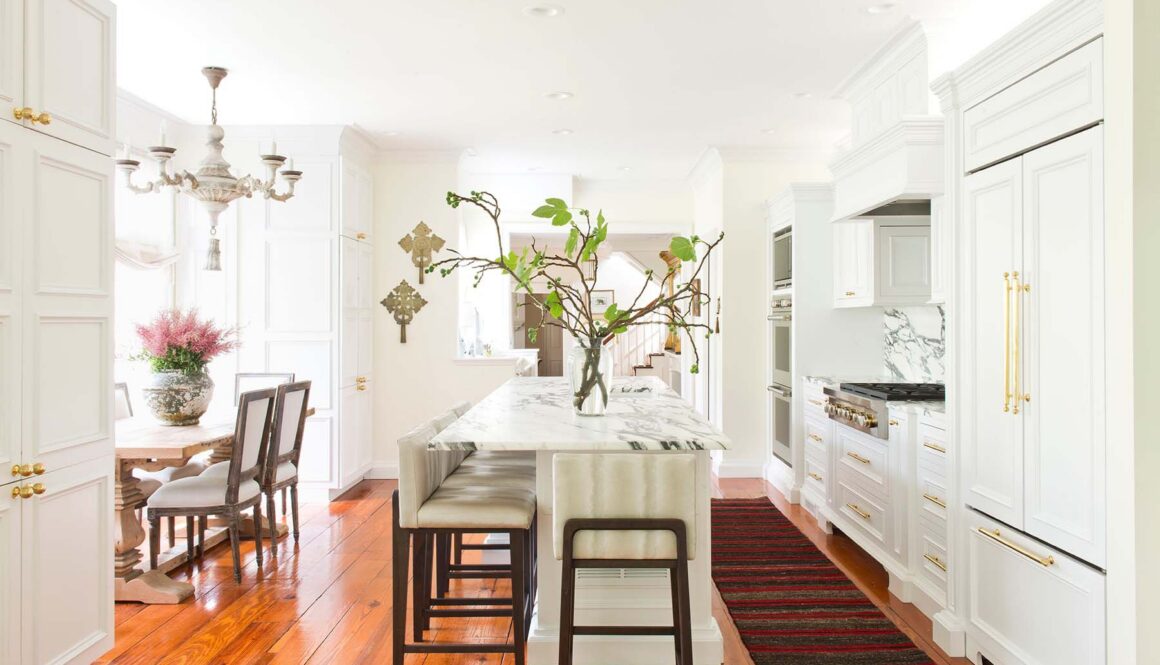
The living and dining rooms carry the most dialogue between old and new, original mantels and moldings treated with reverence, then layered with fine materials, considered art, and pieces chosen to last a lifetime rather than a season. In the kitchen, function leads without sacrificing warmth; it reads as a room, not an appliance gallery. The sun porch is the house at its most relaxed, a place where the Lowcountry light does most of the work. Upstairs, the primary bedroom is quieter still, enveloping, tailored, and calm.
None of it happened quickly, and that’s the point. Great craftsmanship is patient, and a home layered this way ages into itself rather than out of fashion.
Recognition
The finished house was featured on the cover of Luxe Interiors + Design (July/August 2021), and has since appeared in Charleston Magazine, Southern Home, The Post and Courier, Charleston Home + Design, and Rizzoli’s The Allure of Charleston. I’m proud of the press, but prouder that it’s still, first and last, a home we love to live in. You can see more of the project in the Harleston Village portfolio.
Designing your own Charleston home
Every project I take on begins the way this one did: with the architecture, the setting, and the things you already cherish. If you’re renovating a historic home as a luxury interior designer in Charleston would approach it, South of Broad, Harleston Village, or beyond, or building something new on the barrier islands, I’d love to hear about it.